
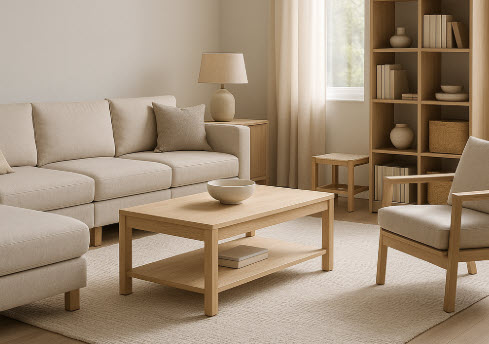
There comes a point in adult life when buying furniture starts to feel less like fun and more like a series of expensive commitments. You picture your sleek new sofa now, and then you picture it awkwardly wedged into your next apartment two years later. But what if furniture did not lock you down? What if it grew with you instead?
Welcome to the world of forever furniture, the modular and flexible pieces designed to evolve as your life does.
The End of Disposable Décor
The idea that furniture should stay in one place forever is as outdated as the word divan. Today’s homes change as quickly as their owners do. People move cities, switch layouts, start families, or go minimalist overnight. And while life shifts, furniture should adapt rather than be replaced.
This is the heart of modular design. It is furniture built on freedom, the ability to reconfigure, expand, and contract without starting from scratch. You buy once, but you keep reinventing.
How Modular Design Works
At its core, modular furniture is about connection. Pieces lock together with hidden joints, magnetic fasteners, or clever brackets that allow you to add or remove sections. A sofa can stretch from a two seater to a sectional. A bookshelf can rise from waist high to ceiling tall. A dining table can collapse into a console when not in use.
It is furniture that listens to your life and rearranges itself accordingly.
Designers call it adaptive ergonomics, the art of making furniture that performs differently depending on where and how you use it. And when it is done right, it does not just save space, it saves your sanity.
From Studio Apartment to Family Home
Modularity has become the silent hero of small space living. Picture a modular couch that splits into two chairs for guests. Or a coffee table that stacks into shelves when you move into a tighter space.
But this is not only for minimalists. Even large homes are embracing modularity because it gives rooms fluidity. Imagine rearranging your living room for a party, then rebuilding it for movie night, all without lifting anything heavier than a cushion.
Some systems go further, allowing fabric swaps, color updates, and new arm styles without replacing the entire piece. It is like changing your outfit instead of your wardrobe.
Design That Ages Gracefully
Forever furniture is not about chasing trends. It is about designing with longevity in mind. Materials are chosen to endure, not just in strength but in visual appeal.
Solid wood frames, replaceable upholstery panels, powder coated metals, and easy to disassemble joinery mean your furniture does not just last, it evolves.
The emotional payoff is huge. You start forming a relationship with your pieces. That sofa you bought in your first apartment might one day live in your guest room, rebuilt in a new configuration and carrying a decade of memories with it.
The Hidden Psychology of Adaptability
There is something deeply comforting about furniture that adapts instead of breaks. It mirrors how we want to live, flexible, capable, and open to change.
Interior psychologists say that modular design reduces what they call decision fatigue. When your space can adapt to multiple purposes, you do not need to constantly buy, sell, or redesign. You simply shift what you already have.
It is the design version of emotional resilience.
The Sustainability Advantage
Let’s be honest. Sustainability has become a bit of a buzzword in design. But modular furniture actually earns it. Every time you reconfigure instead of replace, you cut down on waste and transport.
Some brands even take back old components and refurbish them, giving you credit toward upgrades. Others design parts that can be repaired at home with a simple Allen key and a bit of patience. It is furniture for people who want to buy less but live better.
And because it is built to come apart easily, modular furniture is far easier to move, repair, and eventually recycle. You are not sending a 200 pound sectional to a landfill, you are moving a living system that still works for your new layout.
The Design Scene Leaders
Several design houses are taking this philosophy seriously. Scandinavian studios are focusing on minimal modular lines with natural finishes. Japanese designers have elevated compact systems that turn tiny apartments into flexible living zones. And new North American makers are introducing reconfigurable furniture that looks high end but acts like LEGO for adults.
Even mainstream brands are catching on. You can now find modular sofas, expandable dining sets, and transformable office systems that do not sacrifice aesthetics for function. They are stylish, tactile, and satisfyingly intuitive to assemble.
How to Build Your Forever Setup
Start with the pieces you use most, your sofa, shelving, or work desk. Look for components that can expand or shift. A bookshelf with adjustable height and width is better than one fixed forever. A sectional with removable arms and middle seats lets you change proportions on a whim.
Before buying, ask yourself three questions. Can this grow with me? Can I repair or replace individual parts? Can it adapt to a different space or need?
If the answer is yes, you are not just buying furniture, you are building infrastructure for your lifestyle.
Living Lightly but Fully
The modular movement is not about having less. It is about making what you have more alive. It is about creating a home that keeps pace with your curiosity, your growth, and your changing rhythms.
Every new stage of life deserves furniture that says, I can handle this. The forever furniture edit is not about chasing perfection. It is about designing for evolution, one reconfiguration at a time.